
Why a “good year” for forests changes less than it seems

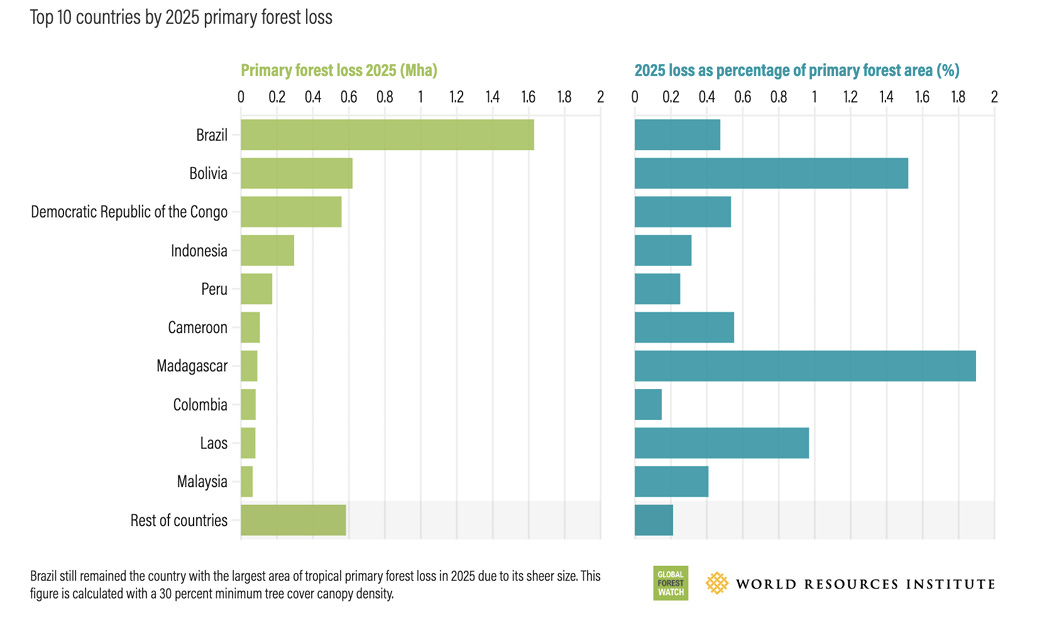
According to data released last week by the University of Maryland’s Global Land Analysis and Discovery (GLAD) laboratory and World Resources Institute’s (WRI) Global Forest Watch, the rate of tropical primary forest loss fell sharply in 2025, reversing the record highs of the year before. On paper, it looks like progress. In reality, the dip is likely only a temporary reprieve.
The decline followed an exceptional year for wildfires. In 2024, drought helped drive some of the largest fire-related losses on record. In 2025, those climatic pressures eased, and the area lost to fire dropped with them. But the root causes—commodity-driven agricultural expansion, patchy enforcement, and growing climate stress—remain stubbornly in place. A single year’s improvement does not shift that fundamental footing.
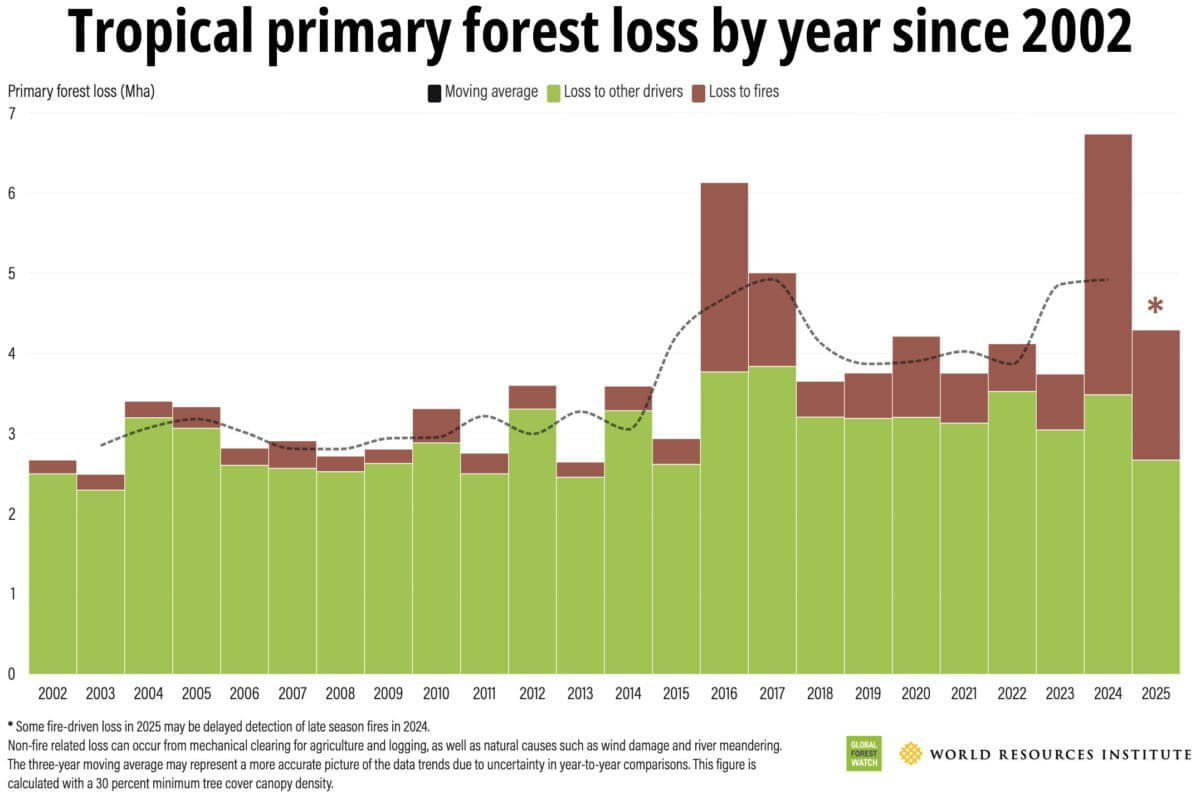
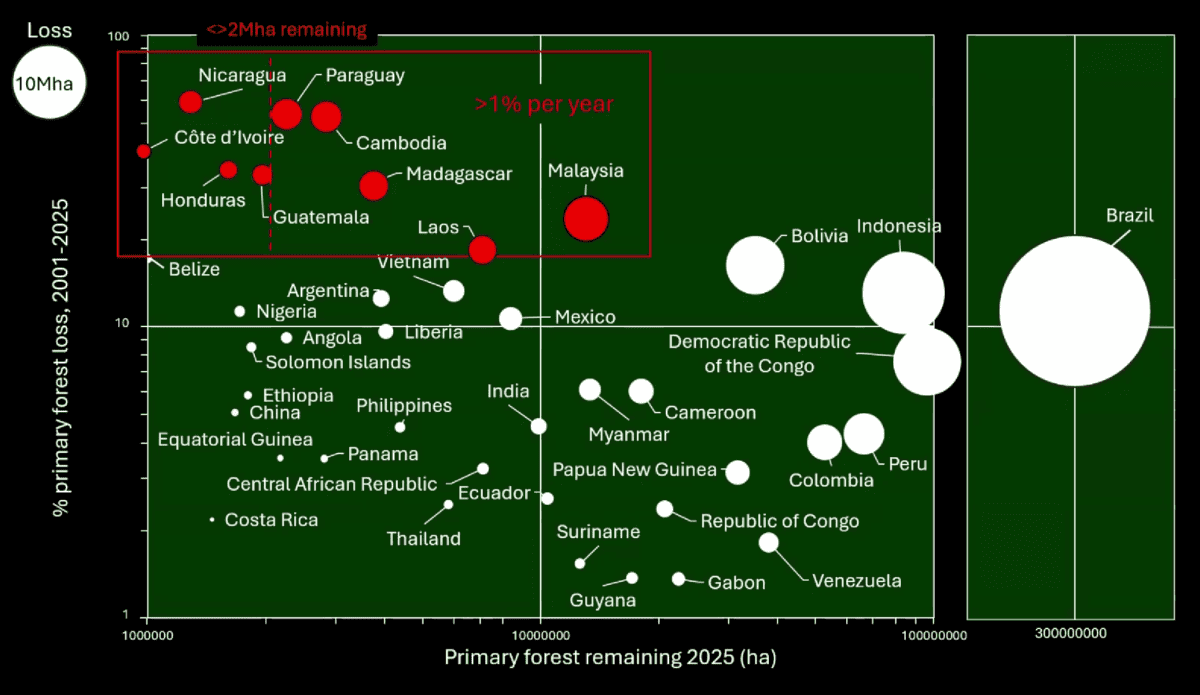
What stands out is the pattern of loss. Forest loss is becoming less predictable, moving in sharper swings tied to weather as much as policy. Fire now accounts for a large share of global tree cover loss, and its behavior tracks temperature and rainfall extremes. When conditions align, losses surge. When they do not, they fall back. But the needle barely moves on the long-term trend: forest loss remains persistently high.
Fire does not simply clear land; it hollows out forests in ways that make further loss more likely. Repeated burns thin canopies and dry the forest floor, eroding the processes that allow forests to recover. In parts of the Amazon, clearing has given way to a self-reinforcing cycle of decay, where degradation serves as a precursor to total forest loss.
Climate is an increasingly active factor. Forecasts point to a likely El Niño in 2026, with drier conditions expected across Southeast Asia and parts of the Amazon. Past events have primed the landscape for fire and stressed forests already under pressure. Today those shocks arrive on top of a hotter “normal,” increasing the chance that each drought ushers in more catastrophic damage.
Policy can still shift outcomes. Brazil’s recent decline in deforestation shows what sustained enforcement can achieve. Satellite alerts suggest that trend has continued into early 2026, with rates approaching historic lows. Indonesia’s longer-term reductions point in the same direction—as well as what progress can be lost when political dynamics shift.
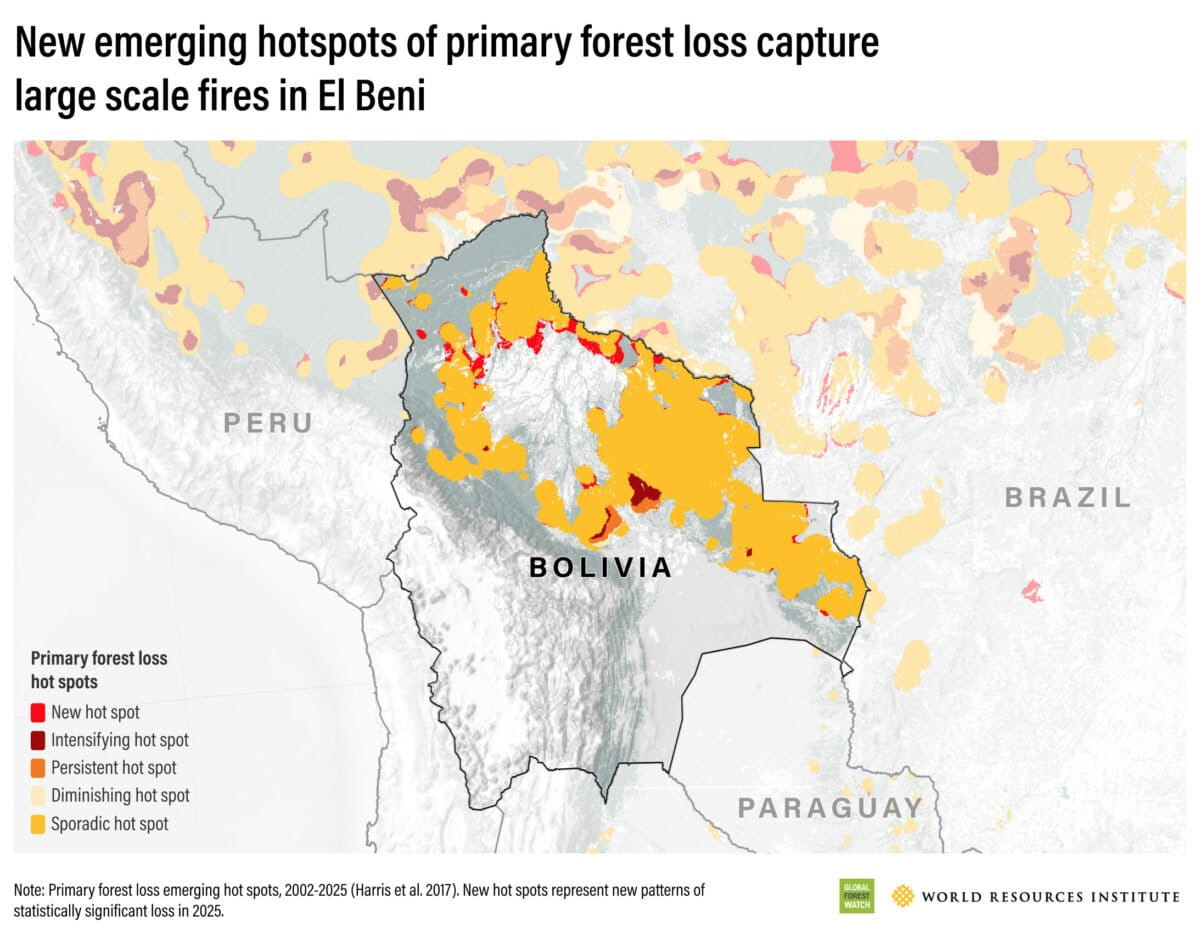
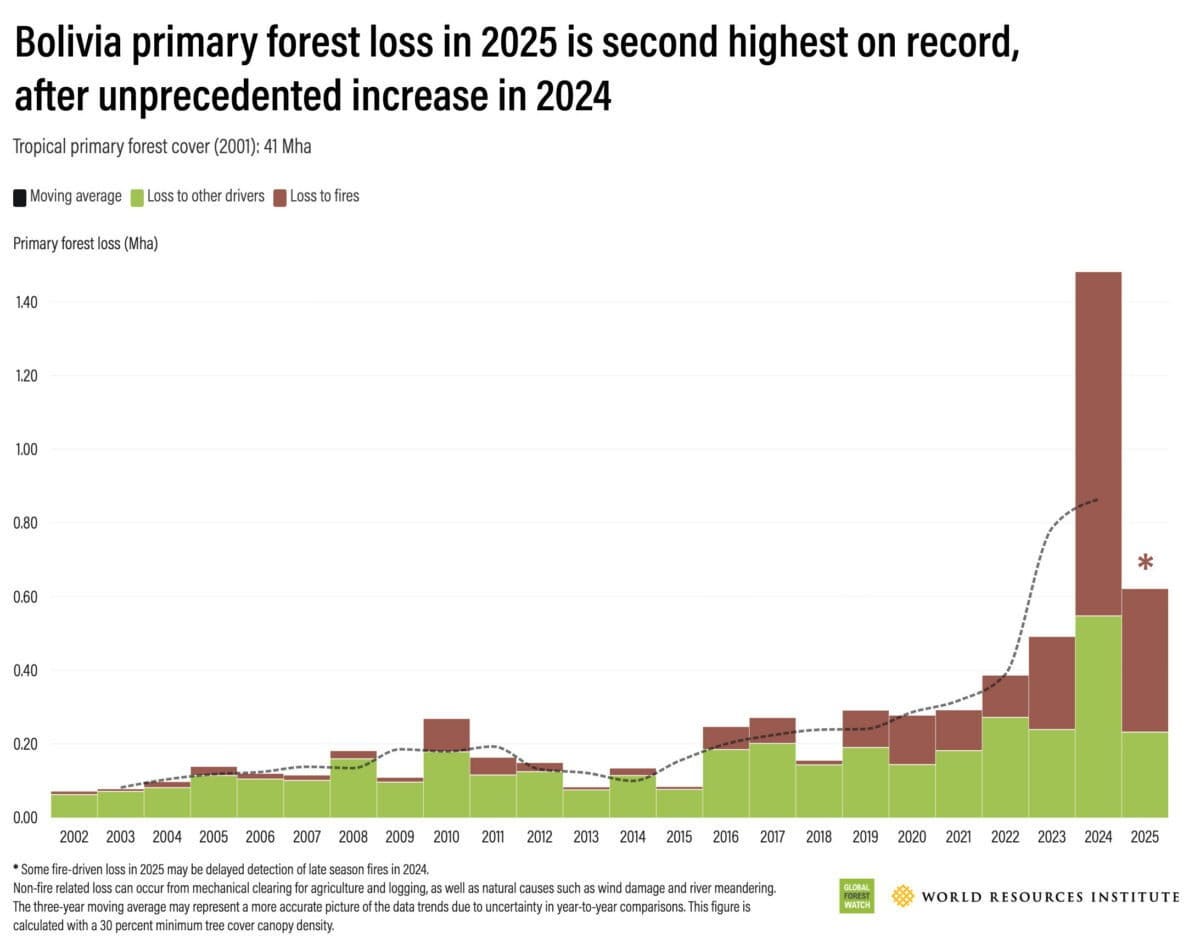
Where governance weakens, loss can rebound overnight. Bolivia’s recent surge and the sharp reversal seen in Brazil during the Bolsonaro administration show how fast progress can unravel. Even in countries making progress, forests are becoming more flammable and more fragmented, leaving them exposed to the next heatwave.
The imbalance is persistent. The economic engines that drive forest loss—farming, industrial plantations, infrastructure, logging, and mining—operate at scale and with steady financing. Protection efforts often depend on shorter-term funding and fickle political support. The result is a pattern of intermittent gains rather than a permanent decline.
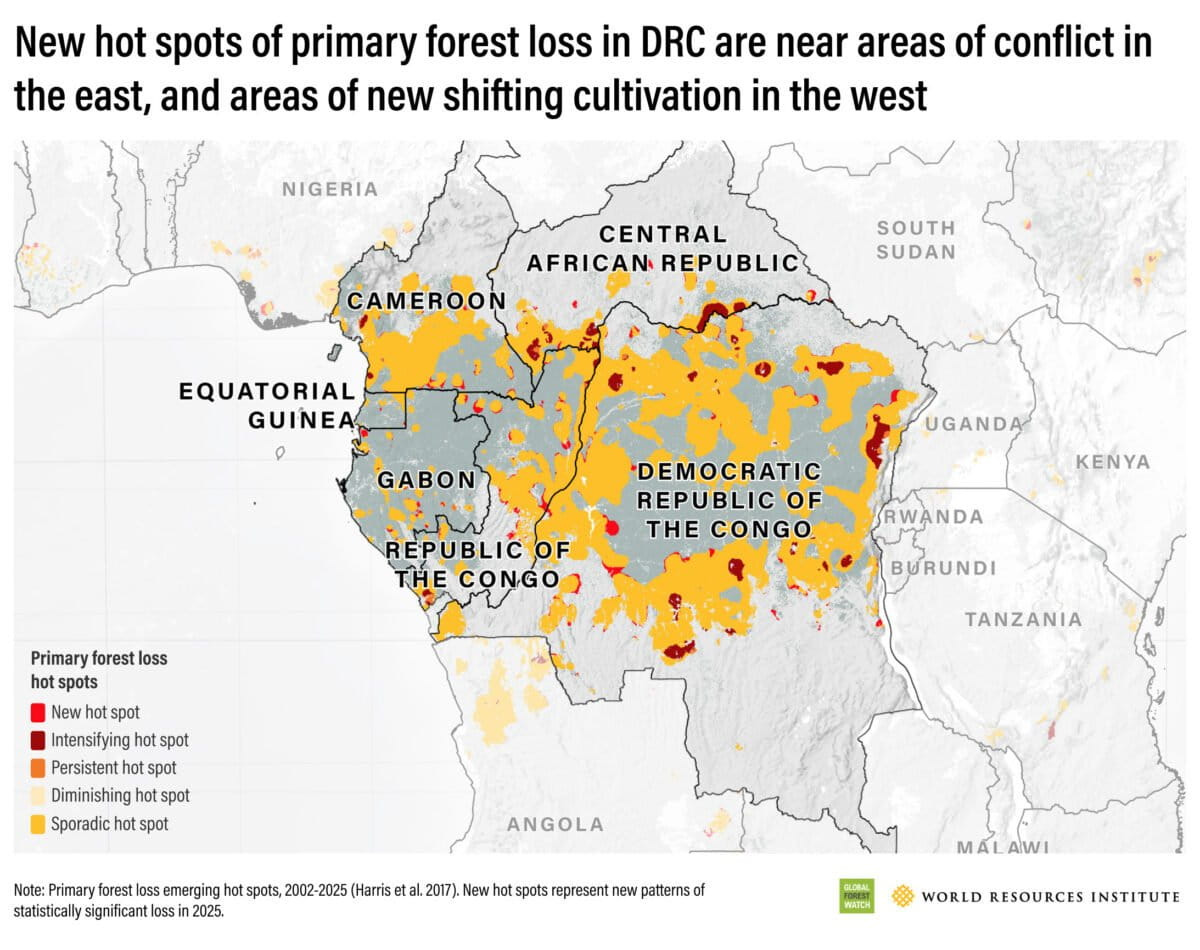
Across the tropics, the landscape itself is becoming more complex. In some regions, new growth appears alongside ongoing clearing, producing a patchwork of recovery and loss. Elsewhere, like the Congo Basin, smaller and more dispersed forms of clearing are creeping in as large frontiers diminish. These shifts muddy the picture without resolving it.
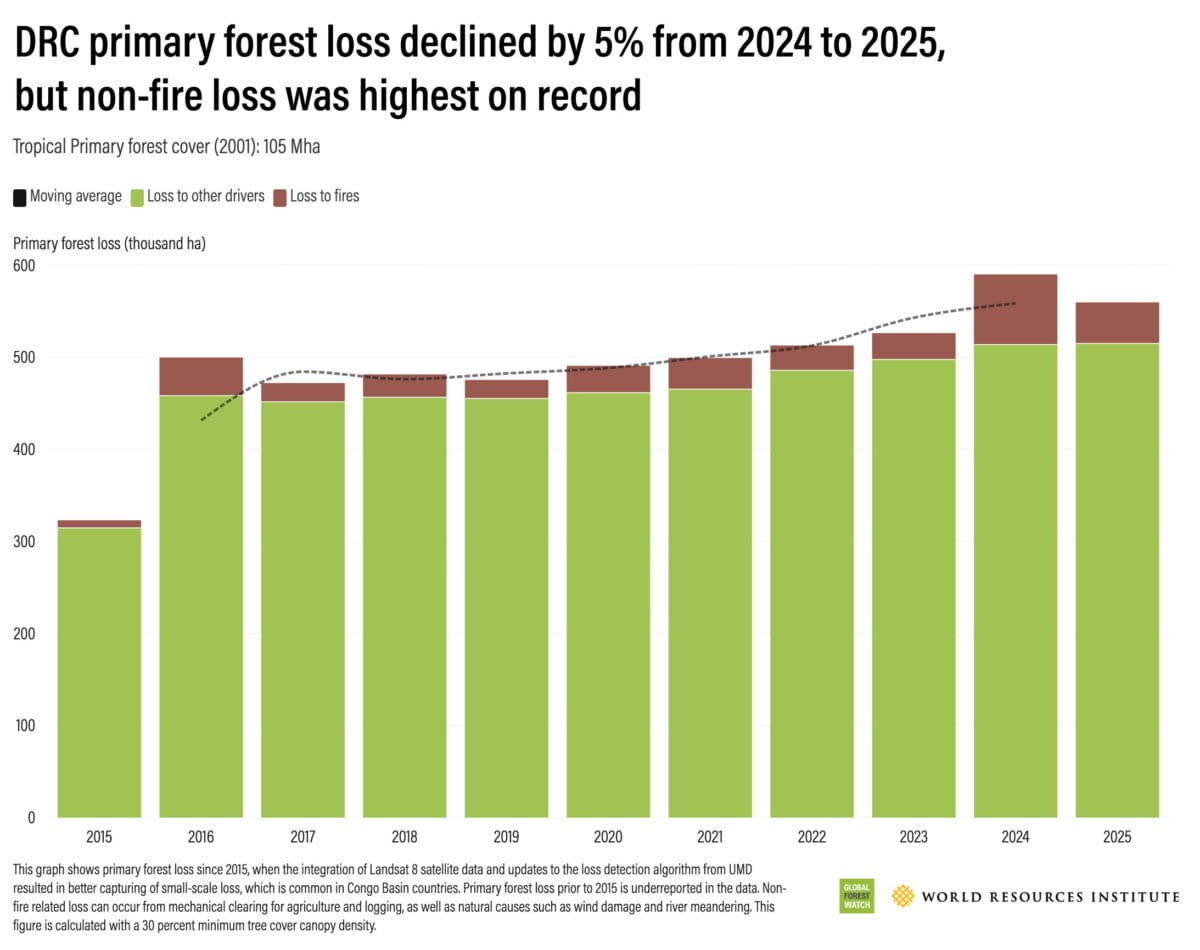
They also mess with the metrics. A hectare lost to fire is counted alongside one cleared for cattle, though the implications differ. A regenerating forest may register as gain, even if it is later cleared again. The data capture change, but often overlook the ecological health and resilience of the forest.
These factors create a set of reinforcing pressures. Climate variability shapes fire. Fire alters forest structure. Degraded forests are more vulnerable to both drought and clearing. Governance determines whether these processes are contained or allowed to spread. None of these forces operate in a vacuum.
The decline in 2025 reflects a moment when several of them moved in a favorable direction. It does not yet mark a shift in the long-term path.
The next few years will test that momentum more directly. If El Niño develops as expected, it will show whether recent gains can withstand a return to drier conditions. A renewed spike in fire would quickly erase them. A more limited response would suggest that policy and management are beginning to take hold.
For now, the direction is uncertain. Forest loss is more sensitive to climate, more disparate across regions, and more dependent on governance that is often fragile. Reductions are possible. But making them stick is another matter entirely.
Other pieces:
A search engine for the planet opens to the public
The idea that the Earth can be “searched” like a database has circulated for several years in academic and technical circles. Earth Index, developed by the nonprofit Earth Genome, brings that idea into practical use.
Tierney Thys, marine biologist and interpreter of the sunfish
In the open ocean, far from coasts and categories, there is a fish that seems to defy the logic of design. It is round where others are tapered, truncated where others trail into a tail. It drifts and dives, basks and vanishes, a presence that appears accidental until one looks more closely. For those who did, the giant ocean sunfish became less an oddity than a set of questions—about form, movement, and how life adapts to a vast and changing sea. Tierney M. Thys, who died in March at 59, spent much of her life asking those questions, and then finding ways to share them. She was a marine biologist by training, though that title alone does not quite capture her range. She was also a filmmaker, a science editor, a National Geographic Explorer, and an advocate for the ocean who moved between research, storytelling, and public engagement. Her work, much of it beyond the ocean, was anchored in curiosity, and in a conviction that understanding the natural world required both analysis and attention.
Species thought extinct for thousands of years ‘rediscovered’ thanks to Indigenous knowledge
On a remote peninsula in Indonesian Papua, a species long thought extinct by scientists has been confirmed to survive. The evidence did not come from a formal survey. It began with conversations with Tambrauw elders, who described a forest glider they had known for generations. Their accounts, combined with earlier photographs, led researchers to verify the continued existence of the ring-tailed glider, reports Mongabay’s John Cannon.
Thank you for showing the data, info, and politics behind the statistics. And reminding me that one measurement in the opposite direction doesn't bend the trent.